Where energy and motion meet discovery
Valenthos Biophysics operates at the molecular decision layer of drug discovery, where binding events are interrogated, mechanisms are resolved, and uncertainty is converted into actionable insight.
Before biology. Before chemistry. Before scale. There is a moment where a binding event must be understood correctly. That is where we work.
Explore Valenthos CapabilitiesWe resolve molecular interactions beyond affinity, integrating kinetics, thermodynamics, and structural context to determine whether a signal is real, meaningful, and actionable.
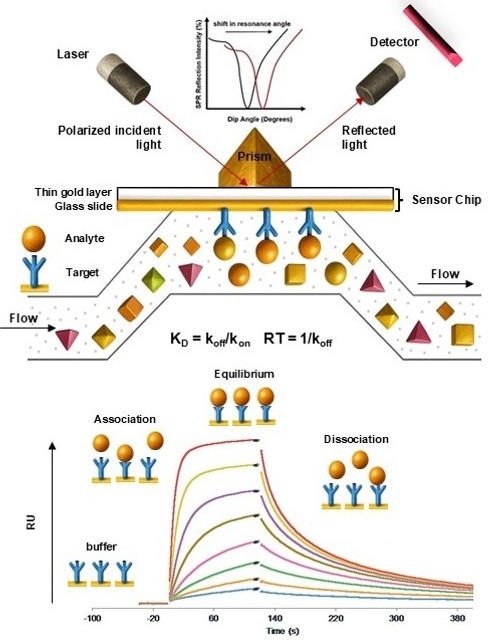
We determine whether an interaction is real, how strong it is, and how it behaves over time by quantifying binding affinity (KD), association and dissociation kinetics (kon & koff), interaction quality and engagement. This establishes whether a molecular signal is robust, reproducible, and suitable for progression.
We resolve the thermodynamic drivers of binding by dissecting ΔG, ΔH, ΔS, stoichiometry and binding-coupled effects such as stabilization, folding, and conformational change. This defines why an interaction occurs and reveals the mechanistic basis required for rational optimization.
We integrate orthogonal biophysical data across multiple platforms to separate signal from artifact and resolve conflicting or ambiguous results. Outputs are structured as decision-focused analyses that define clear conclusions, prioritize hypotheses, and guide next steps.
Drug discovery does not fail because experiments cannot be run. It fails because molecular signals are misunderstood, over-interpreted, or trusted when they should not be.
Valenthos Biophysics operates at the molecular decision layer, before biology, before chemistry, before scale, where binding events must be understood for what they truly are: signal or artifact, mechanism or coincidence, opportunity or dead end.
We do not generate data in isolation. We design experiments with intent, integrate orthogonal biophysical evidence, and translate complex molecular behavior into decision-ready understanding.

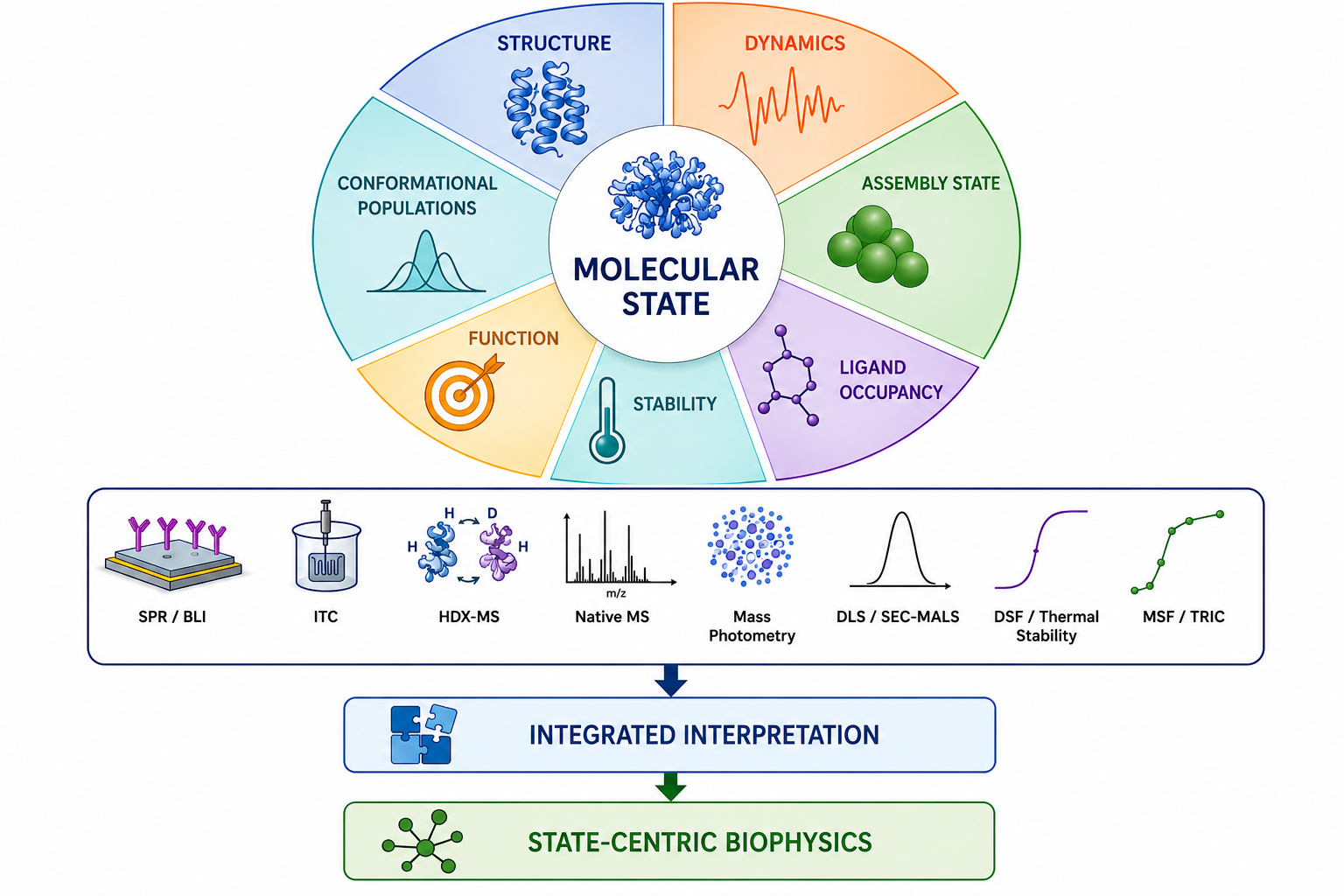
Molecular recognition cannot always be understood through affinity alone. Binding, kinetics, thermodynamics, stability, structural dynamics, hydrodynamics, ligand occupancy, and assembly state provide complementary views of the same molecular system.State-centric biophysics integrates these dimensions to identify which molecular states govern biological behavior and how experimental perturbations redistribute populations across the accessible molecular landscape. The objective is not simply to generate more information, but to build a coherent, experimentally supported description of molecular mechanism.
Dores-Silva, P.R., Pascarella, T.W., Newman, J.M. & Borges, J.C. The rise of state-centric biophysics: integrating orthogonal molecular readouts across biophysical scales. Biophys Rev (2026). https://doi.org/10.1007/s12551-026-01452-9

This is not a measurement workflow. It is a decision framework. By integrating binding kinetics, thermodynamics, and orthogonal validation, we resolve whether an observed interaction reflects true molecular engagement or experimental artifact. Every dataset is interpreted in context, enabling clear, defensible decisions on progression, optimization, or termination.
Rather than reporting isolated parameters, we define the mechanism behind the signal, how it forms, how stable it is, and whether it is actionable. This transforms complex biophysical data into decision-grade understanding.
Pascarella, T.W., Joseph, J.S.,Newman, J.M. et al. Precision by design: Surface plasmon resonance and theintegration of biophysics in fragment-based drug discovery. BiophysRev (2026). https://doi.org/10.1007/s12551-026-01429-8
Our scientific position is grounded not only in technical execution, but in published frameworks for integrating molecular recognition, thermodynamics, structural dynamics, stability, and orthogonal biophysical evidence into decision-grade understanding.
Pascarella, T.W., Joseph, J.S.,Newman, J.M. et al. Precision by design: Surface plasmon resonance and the integration of biophysics in fragment-based drug discovery. Biophys Rev (2026). https://doi.org/10.1007/s12551-026-01429-8
Dores-Silva, P.R., Pascarella, T.W., Newman, J.M. & Borges, J.C. The rise of state-centric biophysics: integrating orthogonal molecular readouts across biophysical scales. Biophys Rev (2026). https://doi.org/10.1007/s12551-026-01452-9
Together, these publications define the scientific foundation of our approach. At the experimental level, we emphasize rigorous assay design, orthogonal validation, structural context, and careful interpretation of molecular signals. At the conceptual level, we extend beyond individual measurements to ask which molecular states are being observed, how those states are perturbed, and whether they are relevant to the biological question being addressed.
The objective is not methodological convergence for its own sake, nor the accumulation of independent measurements. It is to reduce molecular uncertainty and determine when an observed signal is sufficiently supported to inform a discovery decision.
Todd William Pascarella
Director of Biophysics Development
Pascarella.Todd@Valenthosbio.com
Jason Michael Newman
Director of Operations
Newman.Jason@Valenthosbio.com
Paulo Roberto Pascarella
Founder
Paulo@Valenthosbio.com
Valenthos Biophysics operates at the molecular decision layer of drug discovery.
To discuss a project, pilot study, or collaboration, reach out directly:
Newman.Jason@Valenthosbio.com